Swelling During Prescribed Somatropin: Information to Share With Your Clinician
New swelling during prescribed somatropin treatment deserves a clear description and appropriate medical advice. Breathing difficulty or swelling of the face, lips or tongue needs immediate medical help; do not wait to take photographs or finish a symptom record.
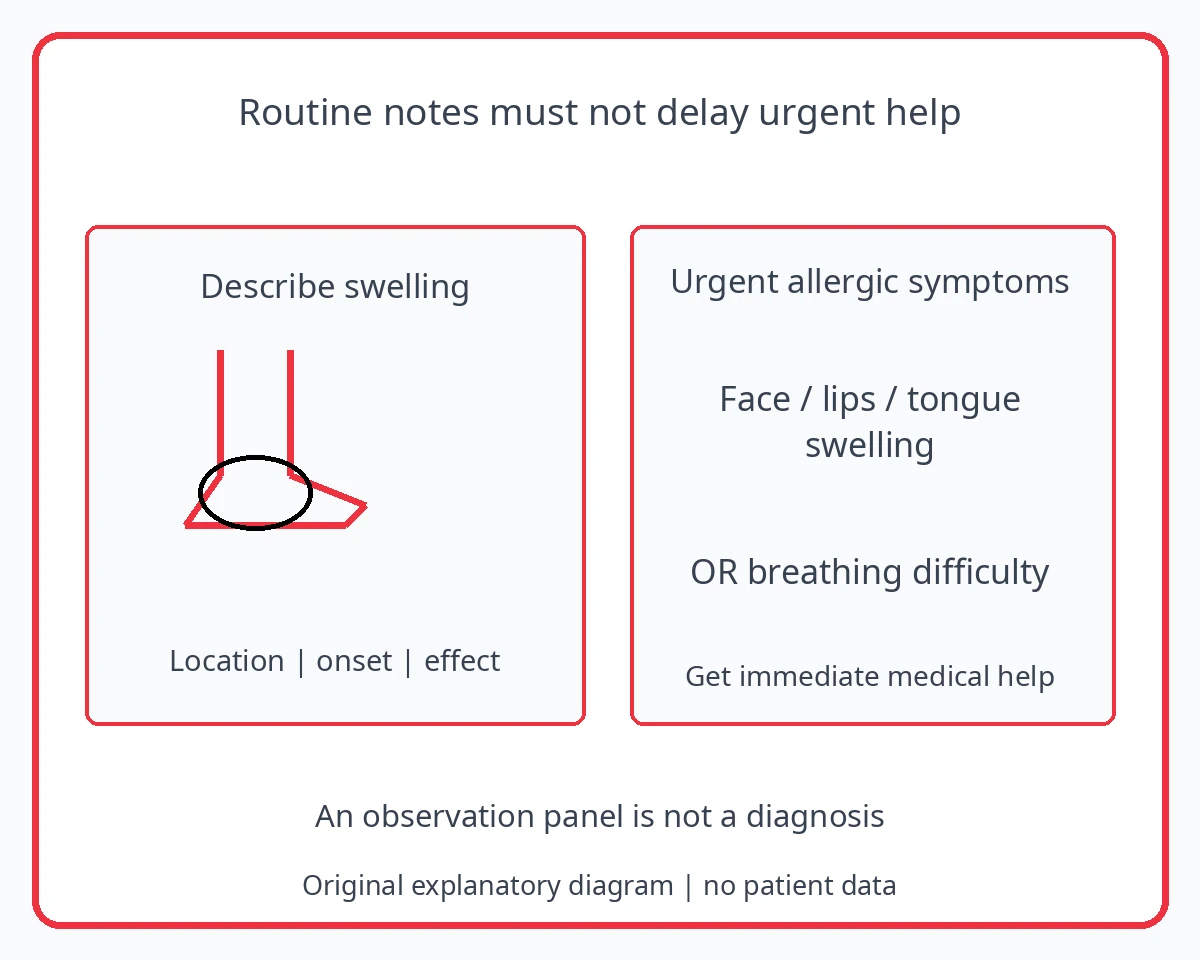
Separate urgent symptoms from a routine record
HealthHub’s somatropin information distinguishes fluid-retention symptoms from serious allergic symptoms. It identifies facial, lip or tongue swelling and breathing difficulty among symptoms requiring immediate help. These examples are not a complete list of emergencies, and the absence of one does not establish that other swelling is harmless.
For other new swelling, contact the team responsible for your treatment for advice. Do not assume that it can be ignored because swelling appears on a side-effect list. A list explains possible problems; it cannot assess your symptoms, other medicines or health history. The record in this article is useful only when making it does not delay the care you need. [1]
Describe what changed without estimating a diagnosis
Begin with the location and side: fingers, ankles or another area, on one side or both. Note when you first noticed the change, whether it has persisted or varied, and any other symptoms. Say “first noticed on Tuesday evening” if that is what you know, rather than claiming it began at an exact time you did not observe.
HealthLink BC encourages specific descriptions of symptoms and daily effects. A ring feeling tighter or a usual shoe fitting differently can make the concern understandable, but neither measures retained fluid nor proves its cause. If you have an earlier comparison, explain what it was. Keep observations separate from conclusions such as “the injection caused this.” [2]
If the concern is a local change at an injection site, record an injection-site change by location and date, keeping a raised area and an indentation distinct.
If discomfort or tingling accompanies the swelling concern, describe joint discomfort or tingling for review as a distinct observation rather than giving every symptom one label.
Making a swelling message more specific
Fictional examples show how to preserve observations. They are not patient results, a validated scale or a monitoring schedule.
| Entry | What the record says | What it does not establish |
|---|---|---|
| Location | Both ankles looked more swollen on 13 October | That swelling is caused by somatropin |
| Timing | First noticed around 19:00; earlier onset unknown | That it began precisely at 19:00 |
| Practical effect | Usual shoes felt tighter that evening | A measured amount of fluid retention |
| Product context | Exact prescribed product and current instructions available | That all GH products have identical instructions |
| Contact | Message sent to the treatment team; response not yet recorded | That advice has been received or the concern is resolved |
A clearer message still leaves the cause open
In this fictional example, “both ankles looked more swollen and my usual shoes felt tighter” communicates more than “a bit puffy.” The added date makes the sequence easier to discuss. It remains a report of what the person noticed, not a diagnosis of a medicine reaction.
The final row also matters. Sending a message is different from receiving instructions. If symptoms are severe, rapidly worsening or accompanied by an urgent warning sign, use an appropriate urgent-care route rather than waiting for a routine reply. Do not use the existence of a sent message as evidence that the situation has been clinically assessed.
Keep clinical advice distinct from your own observations
Have the product name, presentation and current medicine list available when speaking with the team. Include relevant recent changes and health events without selecting one as the cause. If photographs are requested, record the date and use the team’s private sharing route; an image can support the description but cannot determine seriousness on its own.
Write down whom you contacted, the advice actually received and the agreed follow-up. Clarify instructions you do not understand, including what to do while awaiting review. Do not independently change, stop and restart treatment to test a theory about the swelling. The responsible clinician must consider the finding in the context of the exact prescribed product and your circumstances.
For a suspected-event timeline after obtaining care, use Reporting a Suspected Medicine Side Effect: Building a Clear Timeline
Bring the complete current medicine record described in Making a Medication List for a Pituitary Hormone Review
A description does not determine the cause
This article cannot determine the cause or seriousness of swelling from a description or photograph. Follow clinical advice; do not assume it will resolve without review.
Sources and reading context
- HealthHub somatropin patient information — Brand-specific device instructions and questions for the healthcare team; not a universal regimen
- HealthLink BC working with your doctor — Describe symptoms and daily effects; not a diagnostic instrument