Joint Discomfort During Treatment: Preparing for a Medical Review
“Joint pain” can hide several different concerns: stiffness, swelling, tingling or difficulty with a particular movement. Describing the sensation and the task it affects helps a clinician assess it. For a child receiving somatropin, a new limp or hip or knee pain needs prompt medical evaluation.
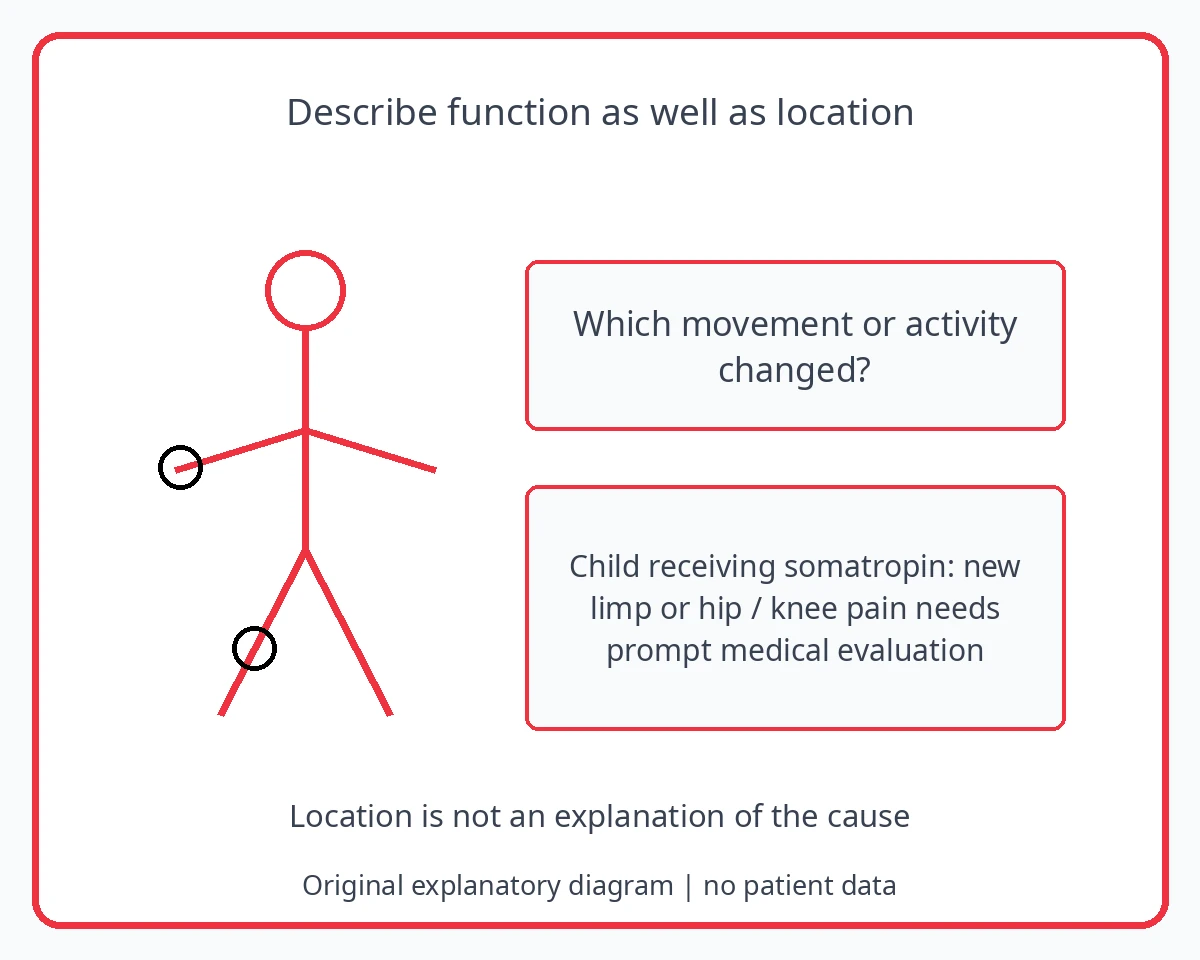
Describe the sensation before choosing a label
The US Genotropin prescribing information includes adult fluid-retention effects such as joint discomfort. This named product label provides a reason to discuss symptoms during treatment; it does not prove that a particular person’s pain is caused by the medicine. Pain, stiffness, swelling and tingling should remain distinct observations when more than one is present.
Locate the concern as precisely as you can in ordinary language. “Tingling in the right hand while holding a cup” is different from “pain at the knee when climbing stairs.” Record whether a similar problem existed before treatment and what has changed. New onset and an older problem becoming more troublesome describe different histories, even if the same body area is involved. [1]
If swelling is also present, describe it using Swelling During Prescribed Somatropin: Information to Share With Your Clinician
Connect the symptom to a familiar activity
HealthLink BC’s advice about working with a doctor supports describing what symptoms do to daily life. Name the movement or activity, what became difficult and when it happens. If you cannot tell whether the difficulty comes from pain, weakness or another sensation, preserve that uncertainty rather than selecting a medical term because it sounds more precise.
Use comparisons you actually remember. A dated note that opening a jar was difficult can be useful; a newly invented severity score for the previous month is less reliable. Add other relevant events, such as an injury or an illness, as context. The purpose is to make assessment easier, not to diagnose a joint or nerve condition from a body diagram. [2]
Replacing a vague heading with the actual concern
Fictional examples show how to preserve observations. They are not patient results, a validated scale or a monitoring schedule.
| Entry | What the record says | What it does not establish |
|---|---|---|
| Original heading | “Joint pain” | Which sensation or activity is involved |
| Location | Right hand; exact affected fingers not recorded | A particular nerve or joint diagnosis |
| Sensation | Tingling while gripping a cup; gripping recently more difficult | That the symptom is fluid retention |
| Earlier history | Similar episodes recalled before treatment; dates uncertain | That this is entirely new |
| Next question | Describe the change and ask the team about review | A choice of pain medicine or hormone adjustment |
A different description can change the question at the visit
The fictional record began with “joint pain,” but the person’s main concern was hand tingling and a change in grip. Keeping those details visible lets the clinician ask a more relevant set of questions. It does not establish why the symptom occurs.
The earlier episodes also belong in the record. Writing “new since treatment” would erase a history the person does remember, even though the dates are uncertain. A more accurate account is “I had similar episodes before, but gripping has recently become more difficult.” The clinician can then assess both the history and the current change.
For examples of observation-based wording, see A Symptom Diary for an Endocrine Appointment: What to Record
Keep the warning for children separate
The Genotropin label specifically calls for evaluation of children who develop a limp or hip or knee pain during treatment. A caregiver should seek prompt medical evaluation for that change rather than borrowing an adult explanation of common discomfort. A child’s altered walking pattern should not be dismissed because an adult symptom list also mentions joint pain.
Adults also need timely clinical attention for severe, sudden or rapidly worsening symptoms rather than waiting for a routine monitoring visit. Follow the care team’s contact instructions and record advice after obtaining help. This article does not select pain treatment, an exercise change or a hormone adjustment; those decisions require assessment of the person and the exact prescribed medicine. [1]
Use the record for assessment, not self-treatment
No pain treatment, exercise modification or hormone adjustment is recommended here. The clinician must assess the symptom and the exact prescribed product in context.
Sources and reading context
- Pfizer Genotropin prescribing information — Exact product label; do not transfer storage, dose or warnings to every GH product
- HealthLink BC working with your doctor — Describe symptoms and daily effects; not a diagnostic instrument