Reporting a Suspected Medicine Side Effect: Building a Clear Timeline
You can raise a concern about a suspected medicine side effect without first proving what caused it. A clear timeline preserves the product, the event and the uncertainty. In Germany, the official PEI/BfArM reporting route is separate from obtaining medical advice, which should never wait for paperwork.
Record an event, not a conclusion
The Paul-Ehrlich-Institut explains that Germany’s spontaneous reporting system collects suspected events noticed in a temporal relationship with medicine use. These reports can help identify questions for further assessment. A symptom occurring after a medicine was used is relevant information, but that order alone does not establish that the medicine caused it.
Describe the health event in ordinary language. Keep a damaged package, a possible mistake in use and a symptom distinguishable if more than one occurred. Include what you know about other medicines, illness or changes around the time. You do not need to choose the most likely explanation yourself before discussing the concern with a professional. [2]
Build the timeline from the records you actually have
Start with the exact product name and presentation, then the dates of use and when the event was first noticed. Keep the package or label information available, including a batch identifier if available. These are useful preparation notes, not a claim about the current portal’s mandatory fields. Follow the official form’s instructions when making a report.
HealthLink BC supports giving specific symptom descriptions and their effects on daily life. Add progression and the practical effect rather than only a diagnostic word you have chosen yourself. Label uncertain dates as approximate. If a later document corrects your memory, retain the earlier uncertainty and add the correction with its source instead of inventing a precise history. [3]
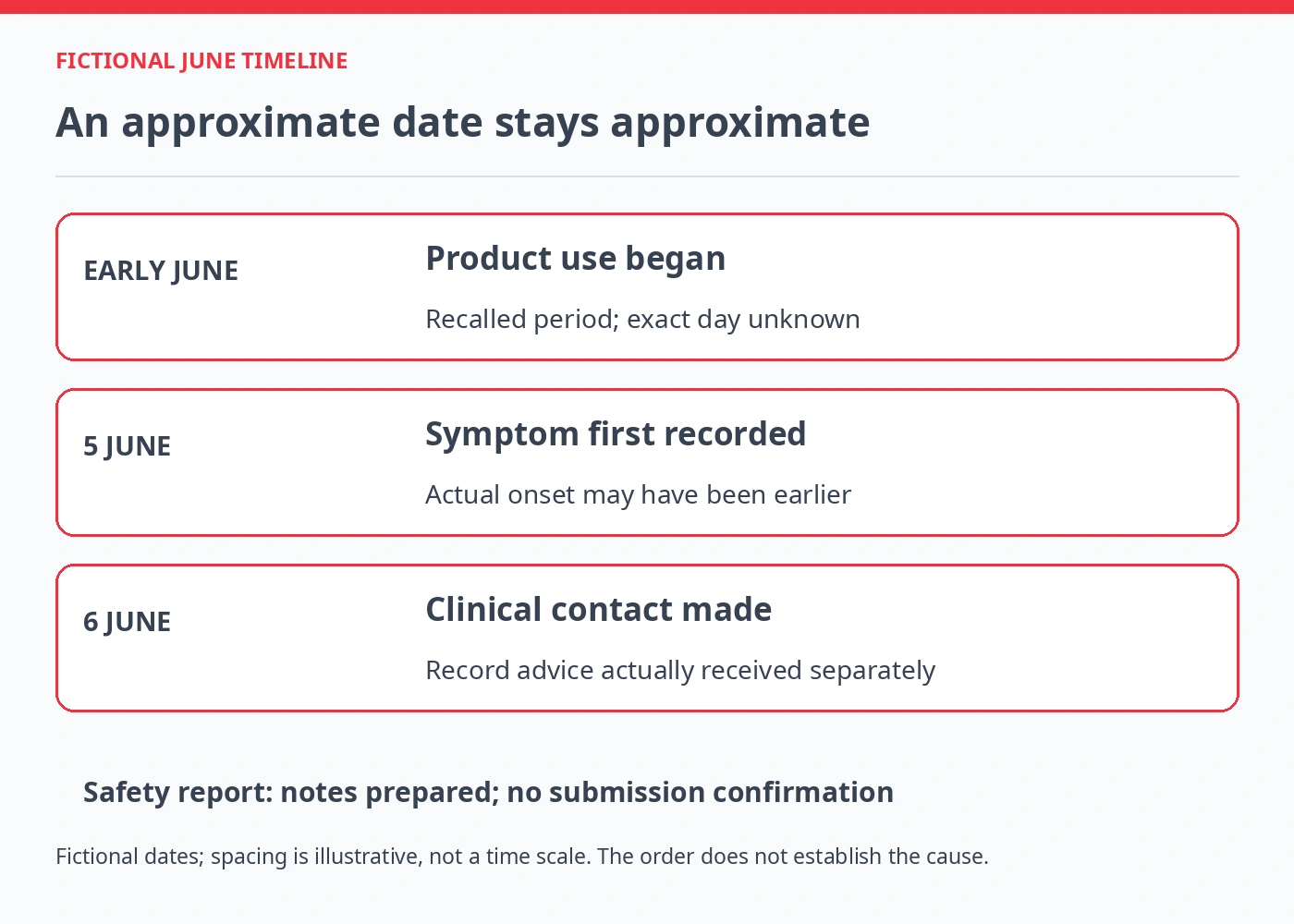
A June timeline with one uncertain starting date
This is a fictional preparation record, not a submitted safety report or a copy of the German online form.
| Event | Available evidence | Uncertainty to preserve |
|---|---|---|
| Product use | Person recalls starting in early June; no dated record yet | Exact starting day unknown |
| Symptom | First noticed on 5 June, according to a dated diary entry | Actual onset may have been earlier |
| Clinical contact | Called the treatment team on 6 June | Record the advice actually received separately |
| Other context | Another medicine was already in use; original label available | Its contribution has not been determined |
| Safety report | Preparation notes saved; no submission confirmation | Do not describe the report as submitted |
A remembered date should not become a false exact date
In the fictional record, the person remembers starting the medicine in early June but knows the symptom was first recorded on 5 June. Writing “started on 3 June” would create detail the evidence does not support. Keep the approximate start and the dated observation as different kinds of information.
The notes can become clearer if a dated prescription or administration record is found, but the sequence still does not prove a medicine reaction. Nor does preparing the notes prove a report reached the authorities. Track the clinical contact, the reporting status and any later clarification separately so another reader can see what actually happened.
For swelling-specific observations and urgent allergic symptoms, see Swelling During Prescribed Somatropin: Information to Share With Your Clinician
Use the German reporting route while keeping care separate
PEI’s patient guidance points to the joint PEI/BfArM portal at nebenwirkungen.bund.de. It describes reporting for yourself or for someone you care for, and stresses that a report does not replace a medical visit. Use the link and current instructions provided on the official PEI page in the sources below; a US MedWatch form is not the German reporting route.
Keep any actual submission confirmation separate from the clinical advice you receive. A saved draft is not a submitted report, and a report reference is not a diagnosis or a treatment instruction. If the portal is unavailable, check the agencies’ current guidance and ask the doctor or pharmacist about reporting; do not delay care or repeatedly submit because the outcome is unclear. Never stop and restart medicine to manufacture stronger evidence for a report. [1]
For official reporting navigation in Thailand, see Finding Official Channels for Suspected Medicine Side Effects in Thailand
A reporting route is not a clinical decision service
A timeline cannot diagnose a medicine reaction. Use current official reporting instructions and seek appropriate medical help when needed; the fictional record is not a completed report or a clinical assessment.
Sources and reading context
- PEI: reporting suspected side effects as a patient or caregiver — German patient/caregiver reporting guidance; follow current official instructions. Reporting does not replace medical care.
- PEI: how spontaneous medicine-safety reports are used — German spontaneous-reporting explanation; suspected events and safety signals are not proof of the cause of an individual symptom.
- HealthLink BC working with your doctor — Describe symptoms and daily effects; not a diagnostic instrument