Injection-Site Changes: What to Record for Your Treatment Team
A raised patch and a shallow indentation are different observations, even if both are called a “lump” in conversation. When an injection-site change appears, keep its shape, location and timing distinct so the treatment team can assess the actual concern rather than a vague label.
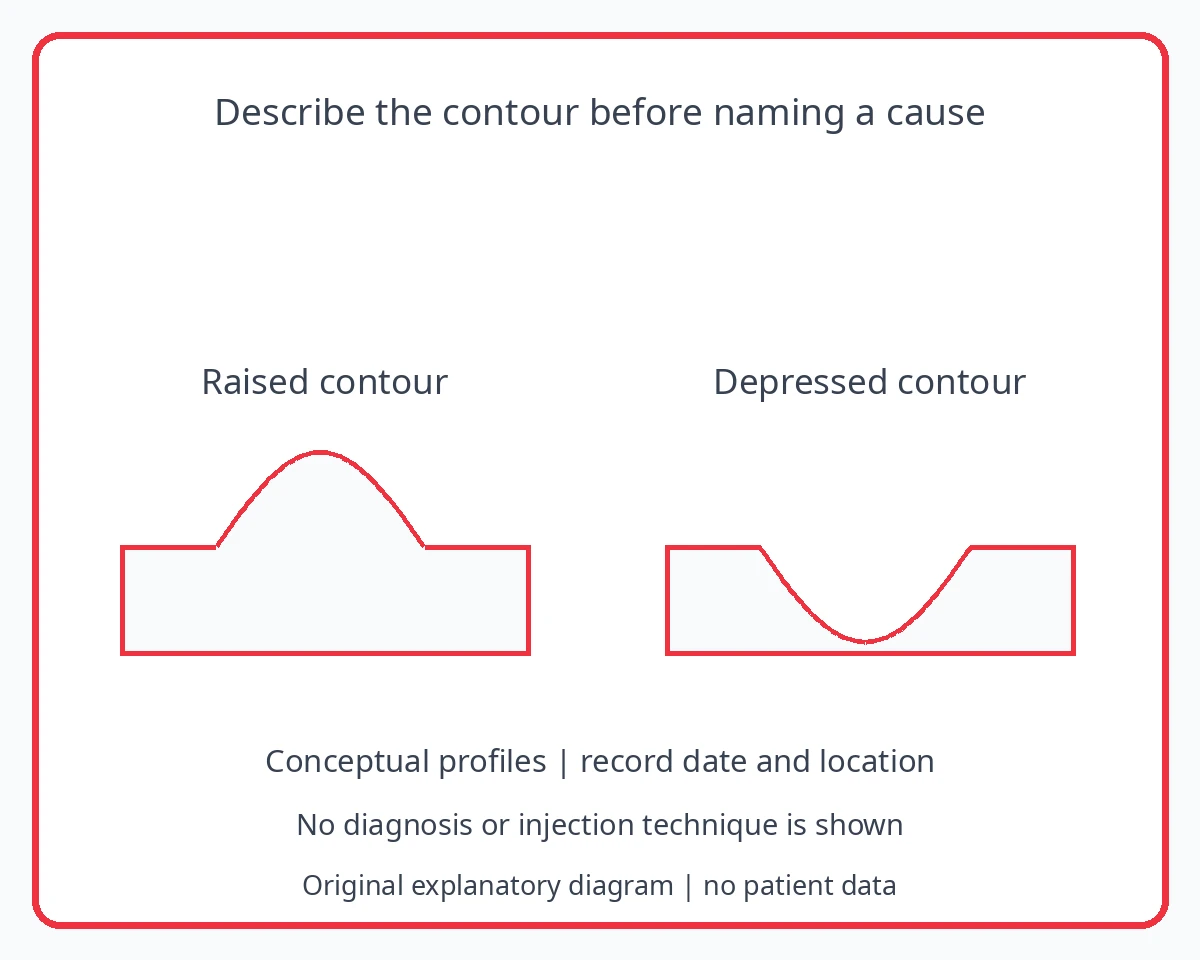
Describe the change before naming its cause
The US Genotropin label discusses local tissue atrophy with repeated injections at the same site. Atrophy means loss of tissue; it should not be used as another word for a raised lump. HealthHub also lists local symptoms such as redness and itching. These references explain why changes belong in a clinical discussion, but they do not diagnose a particular mark from its outline.
Use ordinary descriptions: raised, depressed, red, painful, itchy or changing. More than one may apply. If you cannot tell whether a contour has changed because the lighting is different, keep that uncertainty. The conceptual profiles in the image show only the difference between raised and depressed shapes; they are not pictures of identified conditions or recommended injection sites. [1] [2]
Keep each location and date identifiable
Give each observation a date and a location description that you and the team can recognize. A simple private sketch can help distinguish a change recurring in one area from a different finding elsewhere. If the team requests photographs, retain the dates and use comparable lighting and framing where possible without delaying care to produce a perfect image.
Do not merge two pictures merely because both are associated with the treatment routine. A raised area in one location and a later indentation elsewhere are not evidence that the first turned into the second. Record what can actually be compared, any associated symptoms and the advice received. Avoid pressing, repeatedly probing or otherwise changing the area to make it easier to photograph.
Two observations that should not share one “lump” label
A fictional example illustrates the distinction. It is not a patient record, a diagnostic tool or a treatment instruction.
| Item | Observation or status | What remains separate |
|---|---|---|
| A1, 10 October | Raised area at location A; photograph dated that day | Cause and clinical significance not established |
| B1, 14 October | Shallow indentation at location B; different location | Not a later stage of A1 based on these records |
| Associated symptoms | Person has not yet recorded pain or itching details | Missing information does not mean no symptoms |
| Product information | Exact product and supplied instructions available | A generic diagram does not replace those instructions |
| Review | Team asked to assess both observations | No diagnosis or new technique agreed in this example |
Separate pictures are not automatically a progression
The fictional A1 and B1 images show different contours at different locations. Calling both “the lump getting worse” would add a progression that the records do not demonstrate. A clearer summary is: “I noticed a raised area at A on 10 October and an indentation at B on 14 October.”
The clinician may ask about symptoms, earlier changes or the practical use of the device. Keep those answers with the right observation. If a photograph is unavailable, a clear description is still worth reporting; do not postpone contact because the record is incomplete.
Place the observations in a factual event sequence using Reporting a Suspected Medicine Side Effect: Building a Clear Timeline
Review the concern together with the product instructions
Bring the prescribed product identity and the instructions supplied with it. Tell the team about any difficulty following the device training, and ask for clarification rather than creating a new routine from an online illustration. Instructions about sites and technique need to match the exact product and the clinician’s advice; this article supplies neither a rotation schedule nor an injection demonstration.
Serious allergic symptoms, including swelling of the face, lips or tongue or breathing difficulty, require immediate medical help. Do not treat those as a local skin-record exercise. For other changes, obtain the appropriate clinical advice and preserve what was actually recommended. A photograph cannot by itself establish that a finding is harmless. [1] [2]
Keep the exact product identity with the record as explained in Growth Hormone Brand Names and Generic Names: Reading the Label
The image describes shape, not an injection method
The image does not show where or how to inject. No needle choice, rotation schedule, dosing instruction or diagnosis is supplied. Do not rely on photographs to decide that a change is harmless.
Sources and reading context
- Pfizer Genotropin prescribing information — Exact product label; do not transfer storage, dose or warnings to every GH product
- HealthHub somatropin patient information — Brand-specific device instructions and questions for the healthcare team; not a universal regimen