Reviewing Treatment Goals and Benefits With Your Clinician
To review the benefit of prescribed GH care, return to the goal that mattered at the start. A change on a report or a scale does not automatically answer whether a valued activity became easier. Discuss the different outcomes together with symptoms, effort and what remains uncertain.
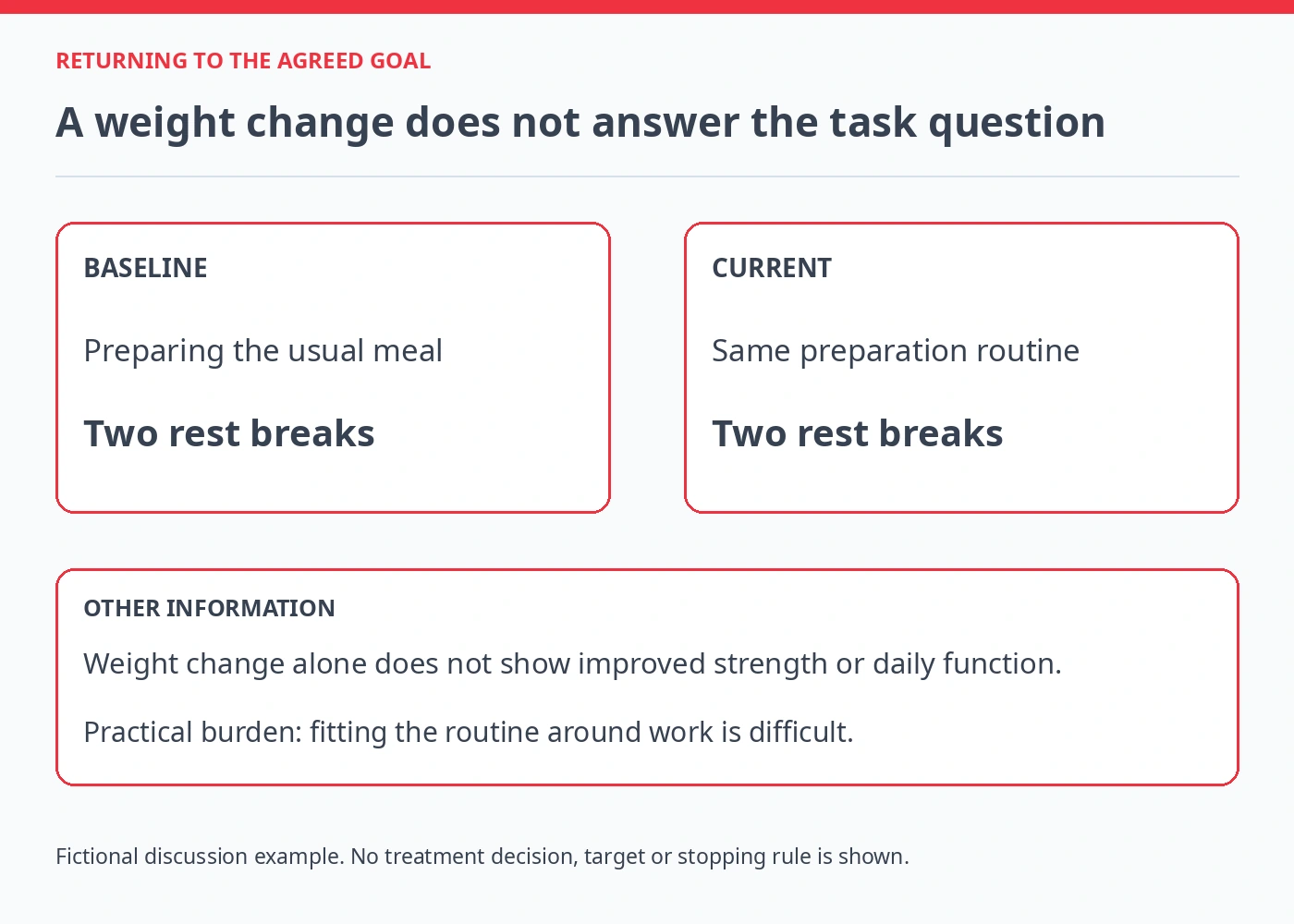
Start with the agreed goal, not the most striking number
The Pituitary Society describes treatment goals in people with GH deficiency in terms of health and quality of life. Keep the review connected to your diagnosed condition and the goals discussed with the clinician. A daily task, a laboratory measurement and a body-composition result describe different things; none should silently replace the original question.
Write down the baseline observation you actually have. If the goal was to manage a familiar household task with fewer interruptions, describe the task and interruptions rather than retrospectively inventing a score. If there was no usable baseline, say so. That limitation does not make your experience unimportant, but it changes how confidently a before-and-after comparison can be interpreted. [1]
For the difference between lean mass and function in research, see Lean Mass and Muscle Strength: Why Studies Measure Both
Compare the same task and keep the competing explanations
Try to compare like with like: the same task under reasonably similar circumstances, or the same type of original report with its dates and units intact. If the task became shorter, someone else helped or an illness interrupted the routine, keep that context visible. An easier task is not necessarily evidence of improved ability to do the original task.
Changes after treatment begins are worth discussing without assuming the medicine caused every one of them. Other care, recovery, sleep and daily demands may also have changed. Do not turn a personal experience into a prediction for another person. Bring the observation, the comparison and the uncertainty so that the clinician can assess them together.
A change in weight does not settle the activity goal
This fictional example demonstrates a way to organize a discussion. It does not identify real products or recommend a treatment combination.
| Item | What is recorded | Question still open |
|---|---|---|
| Original goal | Prepare the usual evening meal with fewer rest breaks | Baseline note records two breaks; not a validated score |
| Current observation | Same meal routine still takes two breaks | No improvement recorded for this particular task |
| Other measurement | Weight differs from the earlier recorded value | Does not establish improved strength or daily function |
| Treatment burden | Person reports difficulty fitting the routine around work | Practical concern to discuss, not proof of treatment failure |
| Next discussion | Review the observations and remaining clinical information | No decision to continue, stop or change treatment made here |
Preserve an unresolved goal even when another measure changes
The fictional person has noticed a weight change but still takes two breaks during the meal routine that originally mattered. Both observations belong in the discussion. The weight record does not resolve the activity question, and the unchanged task record does not independently establish that the whole treatment has failed.
Ask the clinician how the relevant clinical findings, the time course and the person’s experience fit together. If the task comparison was affected by another event, record it. If the goal itself has changed, say why instead of quietly switching to whichever outcome looks more encouraging.
Discuss the trade-offs and the next decision together
AHRQ’s SHARE approach encourages a conversation about options, benefits, harms and what matters to the patient. Bring unwanted symptoms and the practical demands of the prescribed plan alongside any benefit. Ask which findings support the current interpretation, what remains uncertain and what information would help the next discussion.
Write down the decision actually reached and any agreed follow-up, including who is responsible for pending results. If no decision has been made, preserve that status. This review aid does not set a target, a treatment trial length or a stopping rule. It concerns prescribed care for a diagnosed condition and does not promise anti-aging, longevity or performance benefits for healthy people. [2]
Bring these questions to the structured review described in Preparing for a Somatropin Monitoring Appointment
A review aid does not decide treatment
No anti-aging, longevity or performance benefit is promised. This article addresses discussion of prescribed care for a diagnosed condition, not choosing GH for healthy people.
Sources and reading context
- Pituitary Society growth hormone deficiency patient booklet — Patient education, adult history/testing and prescribed-care follow-up; not an individualized protocol
- AHRQ SHARE decision-making resources — Benefits, harms and patient priorities; not a treatment recommendation