Discussing Other Medicines and Supplements During Hormone Care
A medicine review is only as clear as the products on the list. A prescription nickname, an unidentified supplement blend and a product you are only considering should not look like three fully identified medicines you currently take. Bring exact labels and actual-use status to the clinician or pharmacist.
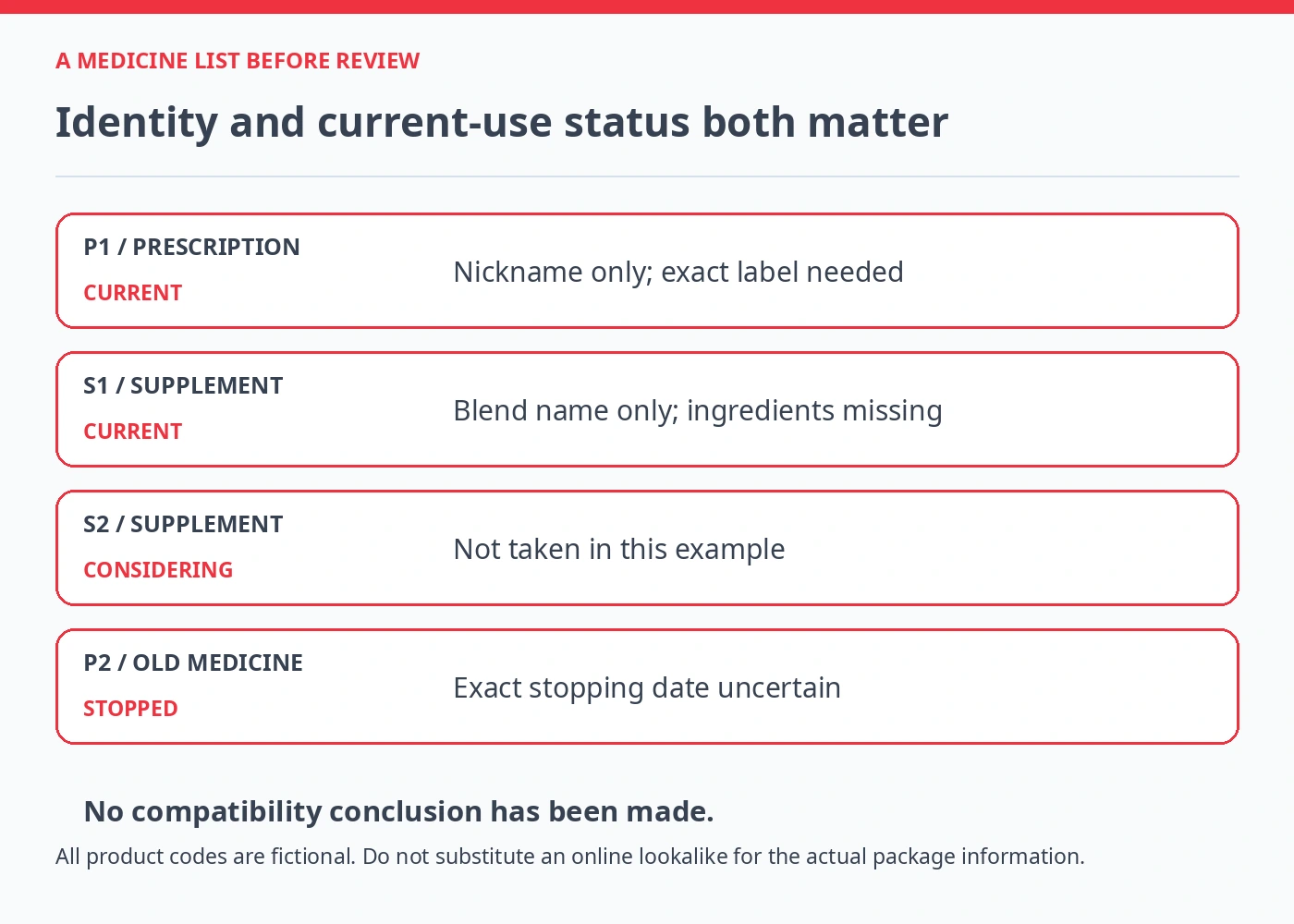
Identify both the product and whether you use it
FDA medication-list guidance includes prescriptions, nonprescription products, vitamins and supplements. Record the name, the strength shown on the package and the instructions you actually follow, with the original label available. If actual use differs from a written instruction, preserve both and ask the team to clarify the difference rather than editing the list to look tidy.
Separate current use from stopped products and things you are considering. Add dates where known and mark uncertain details. A list of everything ever purchased can otherwise make the reviewer assess combinations that are not being taken, while a list containing only prescriptions can omit relevant ingredients. The purpose is an accurate starting point for review, not a list you have already declared safe. [3]
Use the detailed medicine-list format in Making a Medication List for a Pituitary Hormone Review
For a broader explanation of product-specific contraindications, read HGHThai’s somatropin safety guide
Ask how another treatment affects the care plan
The US Genotropin label includes interaction considerations involving glucocorticoids, oral estrogen and glucose-lowering medicines, among others. These examples explain why the exact treatment context matters. They are not a complete compatibility checker, and the presence of a medicine in this discussion is not an instruction to stop or change it.
Ask whether an identified product affects monitoring, interpretation or the plan for your prescribed GH product. Keep the professional’s answer tied to the products and current-use information they reviewed. If another prescriber later changes something, tell the responsible team rather than assuming the earlier review automatically covers the new situation. [1]
A list that is not yet ready for an interaction review
This fictional example demonstrates a way to organize a discussion. It does not identify real products or recommend a treatment combination.
| Item | What is recorded | Question still open |
|---|---|---|
| Prescription P1 | Current use confirmed; list contains only a nickname | Add the exact label and current instructions |
| Supplement S1 | Currently taken; bottle says “wellness blend” | Ingredient panel and amounts are still missing |
| Supplement S2 | Advertised online; person is considering it | Do not record it as already taken |
| Old medicine P2 | Stopped previously; exact date uncertain | Keep status and date uncertainty visible |
| Review outcome | Pharmacist has not yet assessed the complete information | No compatibility conclusion has been made |
A similar online product is not a substitute for the label
In the fictional list, S1 lacks the ingredient information needed for a meaningful review. Finding another “wellness blend” online and copying its ingredients would create a false record, especially if the formulation or serving size differs. Use the label from the actual product and ask about details that remain undisclosed.
S2 creates a different problem: it has not been taken. Keeping it in a “considering” category lets the pharmacist discuss it prospectively without treating it as part of the current combination. Neither improving the list nor receiving a marketing claim establishes that a product is useful or compatible with the person’s care.
Separate supplement evidence from compatibility
The NIH Office of Dietary Supplements explains that supplements can cause unwanted effects and interact with medicines; “natural” does not guarantee safety. Bring the ingredient information and the amount actually used, not only a name such as “hormone support.” A marketing claim about quality or hormones does not by itself demonstrate a useful clinical outcome.
Two questions remain distinct: is there good evidence for the claimed benefit, and is this product appropriate alongside your medicines and health conditions? An answer to one does not settle the other. Record the professional advice and the information it was based on. Do not start, stop or alter products to influence a hormone result without appropriate clinical advice. [2]
For evaluating supplement evidence separately from compatibility, see Reading 'Hormone Boost' Supplement Claims Critically
Once the list is ready for review, use it to prepare the monitoring appointment, with an owner and next step for any compatibility question left unanswered.
An accurate list supports, but does not replace, review
This guide cannot determine compatibility or replace an interaction review. Do not start, stop or alter a prescribed medicine or supplement to influence a hormone result without appropriate clinical advice.
Sources and reading context
- Pfizer Genotropin prescribing information — Exact product label; do not transfer storage, dose or warnings to every GH product
- NIH ODS dietary supplements information — Ingredient disclosure and claim assessment; no endorsement of hormone boosters
- FDA medication-list guidance — Organization of existing prescribed instructions, OTC products and supplements; not prescribing advice