Why Your Treatment Team May Discuss Thyroid Tests
A thyroid test request during GH care is not necessarily a new diagnosis or a change of subject. Pituitary care can involve several hormone pathways. The useful question is what the team wants to assess and how that result will fit with the treatment and reports you already have.
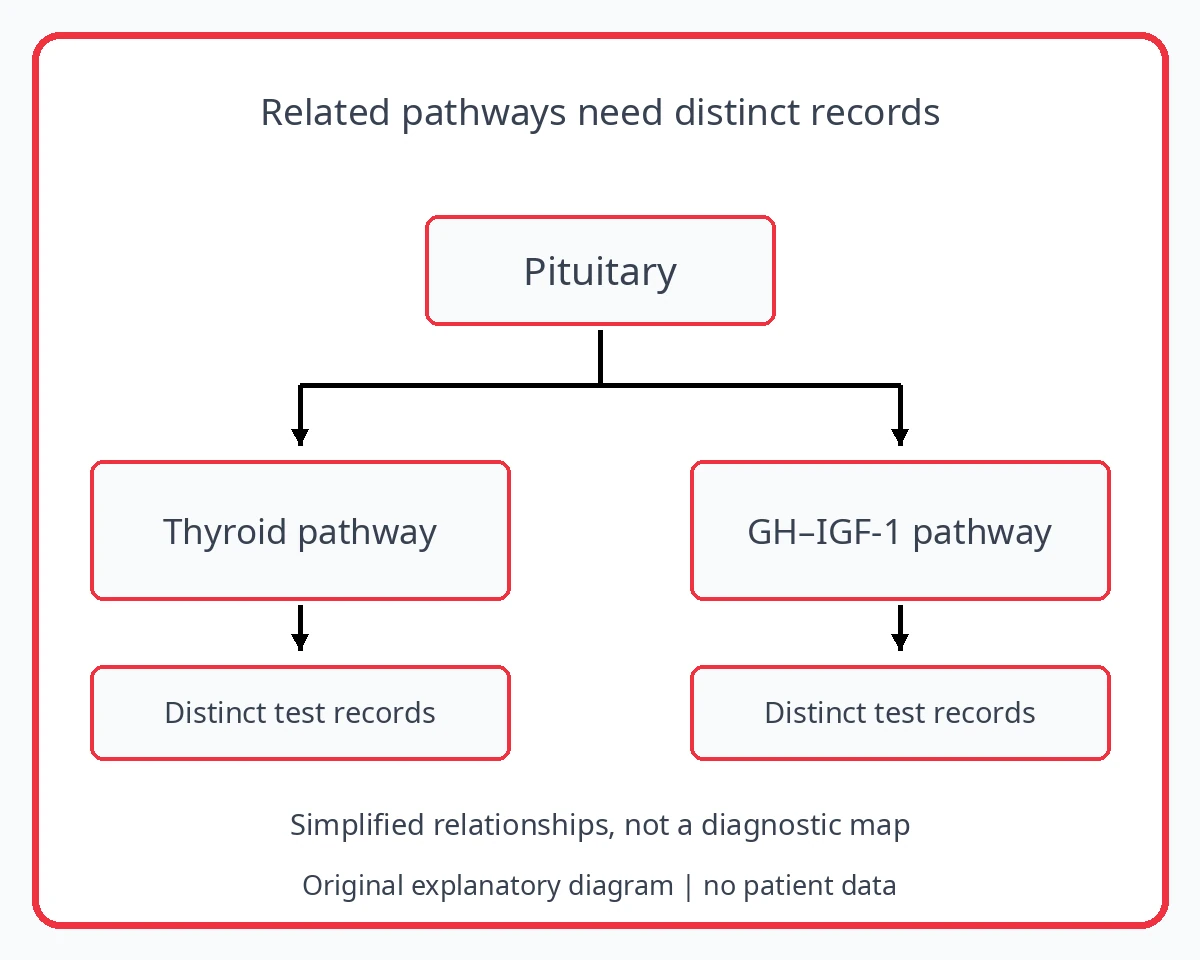
Related pathways still need distinct records
The Pituitary Society explains that the pituitary produces several hormones and influences other glands. GH-related care therefore does not always concern GH alone. The thyroid pathway and the GH–IGF-1 pathway belong within a wider endocrine picture, but their tests do not become interchangeable because they were ordered by the same service.
Keep the exact test names from the request and original reports. A folder called “hormones” can hold them together, but each file still needs its own sample date and identity. The simplified diagram in this article separates the questions; it does not show every feedback relationship or allow a diagnosis to be made from the position of an arrow. [2]
Why thyroid function may be part of prescribed follow-up
The US Genotropin label notes that central, or secondary, hypothyroidism can become apparent or worsen in people with GH deficiency during treatment. It also describes the effect of unrecognized or untreated hypothyroidism on response. These are reasons for a clinician to consider thyroid function, not instructions to diagnose yourself from tiredness or select your own panel.
Tell the team about an existing thyroid diagnosis and the actual medicines and instructions you follow. Ask whether the current request is routine monitoring of known care, investigation of a change or assessment of the wider pituitary situation. The answer depends on your history and the prescribed product; the request alone does not tell you which explanation applies. [1]
Keeping a thyroid request distinct from a conclusion
This fictional record illustrates coordination of an existing care plan. It is not a recommended test panel or testing interval.
| Item | Recorded status | Question to clarify |
|---|---|---|
| IGF-1 report | Sample dated 6 October; original report available | How does the clinician interpret this measurement? |
| Thyroid request | Issued 14 October; appointment not yet confirmed | What question is being investigated? |
| Existing medicine | Current thyroid medicine listed with its actual instruction | Does the team have the current information? |
| Coordination | Endocrine service requested the test; usual prescriber also involved | Who will explain and communicate any agreed change? |
| Diagnosis status | No new diagnosis recorded in this example | Do not infer one from the request alone |
A request is a question, not an answer
The fictional record contains an available IGF-1 report and a new thyroid test request. Calling both “the hormone result” would hide that one is a report and the other is still a planned investigation. Writing “new thyroid disease” would go further still, adding a conclusion that nobody has recorded.
A clearer message is: “I have the IGF-1 report for the sample taken on 6 October and a thyroid request dated 14 October. What is the thyroid check intended to assess, and who will explain the result?” That keeps the care connected without treating two measurements as the same evidence.
Resolve instructions between teams before making changes
Bring the original reports and a current medicine list. Keep the reason for each planned check beside the request if the team has explained it. When different services are involved, identify who coordinates the findings and how the other prescriber will receive the relevant information. Do not silently combine conflicting written instructions into a new plan.
After the discussion, record what was explained, what remains pending and any action actually agreed. If wording is unclear, repeat your understanding and ask the team to confirm it. Do not alter thyroid medicine to influence a GH-related result or assume a test request cancels your current prescription. Any treatment change needs the responsible clinician’s assessment.
Include other prescribed treatments using Discussing Other Medicines and Supplements During Hormone Care
To keep the separate reports traceable, use Organizing Laboratory Results for a Pituitary Appointment
A simplified pathway map is not a diagnosis
This article does not diagnose central hypothyroidism, recommend thyroid replacement or select a test panel. The named US label is not a statement of approval or service availability in another country.
Sources and reading context
- Pfizer Genotropin prescribing information — Exact product label; do not transfer storage, dose or warnings to every GH product
- Pituitary Society growth hormone deficiency patient booklet — Patient education, adult history/testing and prescribed-care follow-up; not an individualized protocol