Keeping a Monitoring Diary During Prescribed Growth Hormone Treatment
A useful diary during prescribed growth hormone treatment can hold two truths at once: a familiar task feels easier, and a new symptom needs attention. Keep daily function, unwanted symptoms and clinical results in separate entries so that one encouraging observation does not hide another concern.
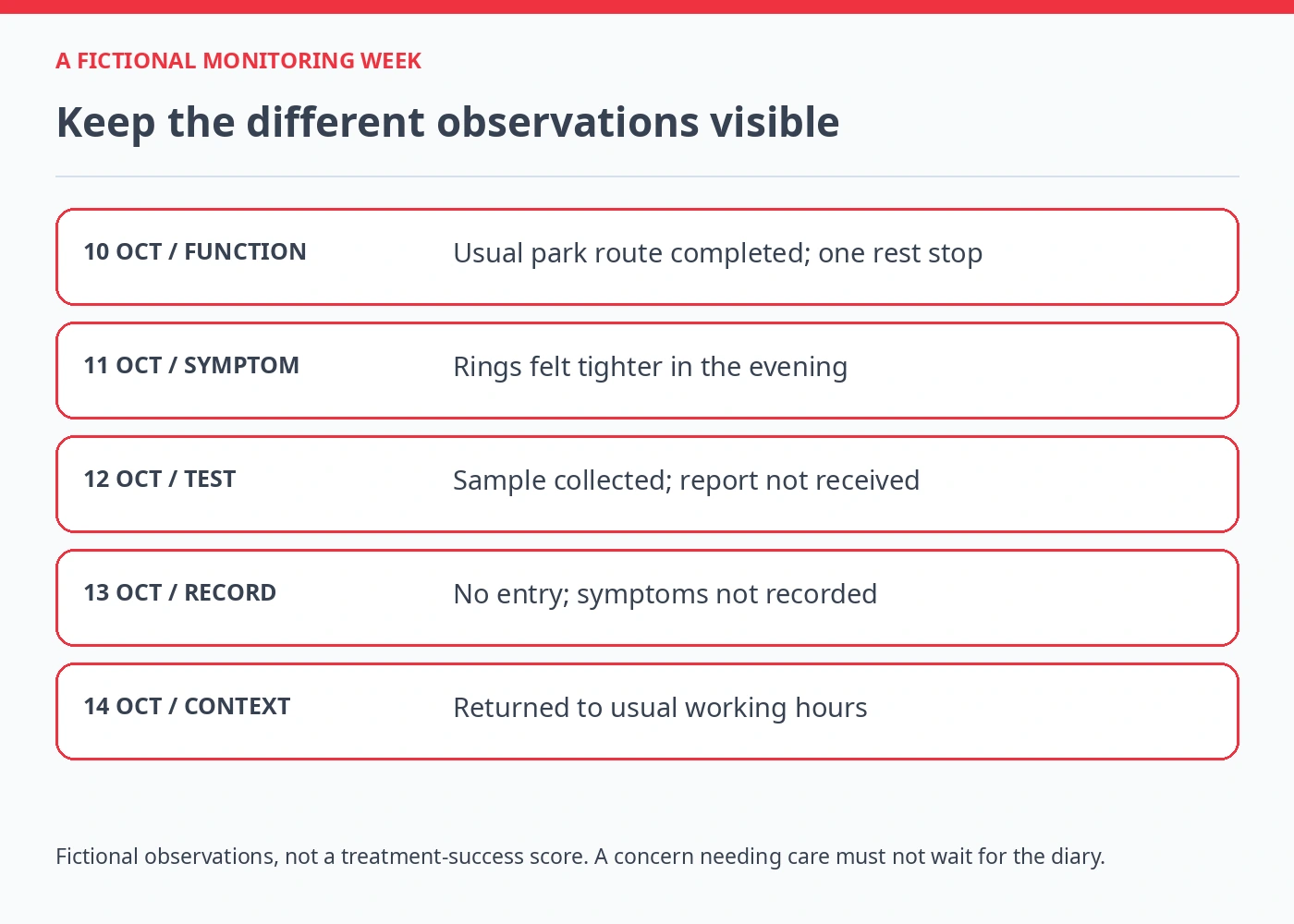
Give each observation its own question
The Pituitary Society describes follow-up as an assessment of response and safety, with blood tests contributing to that review. Your account of daily life adds a different kind of information. Finishing the usual walk, a change in how your rings fit and a laboratory report are not interchangeable measures of whether treatment is going well.
Choose descriptions that can be revisited. For a walk, note the route and what you actually managed, rather than writing only “more energy.” For a symptom, record what changed and when. Put an illness, a different work pattern or a clinician-directed treatment change alongside the observations as context. Their timing may matter, but it does not identify the cause. [1]
Make a short entry that another person can understand
HealthLink BC recommends describing symptoms and their effects specifically when working with your doctor. Apply that idea to the diary: “I stopped once on my usual route” gives a clearer starting point than “a good day.” If the route was shorter or you walked with someone at a different pace, keep that difference visible rather than treating the entries as equivalent.
Record dates when you can, and label estimates when you cannot. A blank day means no entry was made; it does not mean there were no symptoms. Avoid adding unrelated observations into a home-made GH score. A single total can hide the fact that function improved while discomfort increased, and it has no established meaning for a treatment decision. [2]
One week, three different kinds of information
Fictional examples show how to preserve observations. They are not patient results, a validated scale or a monitoring schedule.
| Entry | What the record says | What it does not establish |
|---|---|---|
| 10 October: function | Completed the usual park route; one rest stop | A medicine effect, or a comparison with a different route |
| 11 October: symptom | Rings felt tighter in the evening; first recorded today | Fluid volume or the cause of the change |
| 12 October: clinical record | Blood sample collected; report not yet received | A result already reviewed by the team |
| 13 October: diary | No entry | A symptom-free day |
| 14 October: context | Returned to usual working hours | That work or treatment explains every change |
Keep the mixed picture instead of choosing a verdict
The fictional week contains something the person values, a symptom to discuss and a test whose result is still missing. Calling the week “successful treatment” would lose two of those three questions. Calling it a failure would also go beyond what the record shows.
A useful visit summary is more specific: “I managed the usual route with one stop, noticed tighter rings the next evening and am waiting for the blood report.” The longer diary can supply context if the clinician asks. Reporting a concern must not wait until the week is complete or until the laboratory result arrives.
For clearer descriptions of individual symptoms, see A Symptom Diary for an Endocrine Appointment: What to Record
For the wider safety context of somatropin follow-up, read HGHThai’s somatropin monitoring overview
Turn the diary into a conversation and a follow-up record
Before a planned visit, identify the changes that matter most to you and bring the original reports as well as the diary. Keep “sample taken,” “report received” and “clinician explained result” distinct. If the team corrects an entry, retain the original observation and add the clarification with its date rather than silently rewriting the history.
Ask which observations are useful for your particular follow-up and how to contact the team between visits. Record the advice actually given and any remaining question. The diary supports that care plan; it does not set a testing interval, choose a target or tell you to adjust treatment. If a symptom needs urgent attention, obtaining help takes priority over documentation.
To turn the diary into a focused review visit, use Preparing for a Somatropin Monitoring Appointment
For the benefit part of that discussion, review treatment goals against the same daily task and keep treatment burden and competing explanations visible.
What a diary can and cannot decide
No monitoring frequency, target value or medicine adjustment is supplied. Use the contact plan and instructions from the team responsible for your prescribed treatment.
Sources and reading context
- Pituitary Society growth hormone deficiency patient booklet — Patient education, adult history/testing and prescribed-care follow-up; not an individualized protocol
- HealthLink BC working with your doctor — Describe symptoms and daily effects; not a diagnostic instrument